
Game guides
How to Play Lightning Dice: Totals, Strikes and Real Payouts
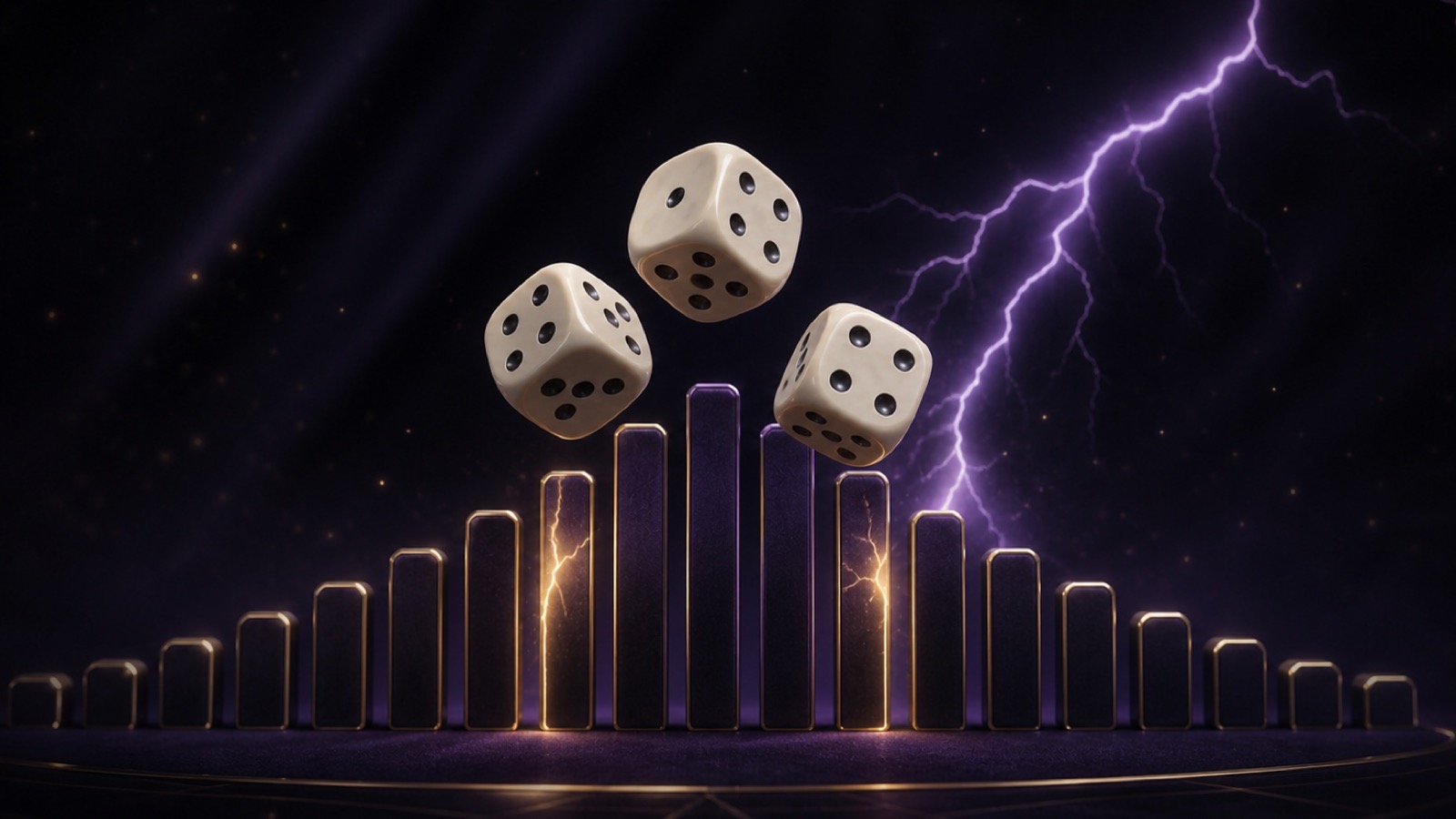
Lightning Dice turns the probability curve of three dice into the betting board. Choose any total from 3 to 18, watch random rungs charge with 2x, 3x or 5x lightning, then roll. If the dice add up to a total you backed, its current rung value settles the wager.
The important rule is simple: lightning changes the payout, not the chance of the total. Every result still comes from one of 216 equally likely three-dice combinations. This guide prints that complete probability ladder and the current return attached to each rung at Lightning Dice on Havoc Win.
How to play Lightning Dice step by step
- Choose one or more totals. Tap any rung from 3 through 18. The board shows the return attached to each selected total.
- Check the total stake. If you select several totals, the wager is divided evenly between them. The displayed rung value reflects that split.
- Start the roll. Each total has an independent chance to be struck by lightning before the three dice finish landing.
- Read the final sum. The dice land one at a time. After two dice, the ladder highlights the six totals the last die can still make.
- Settle the selected rung. A matching total returns its displayed base value, multiplied by 2x, 3x or 5x when that rung was struck. Unmatched selections return nothing.
The third-die window is information about arithmetic, not a decision point. It shows what remains possible from the two visible dice, but the wager is already committed and the hidden die has not become predictable.
Lightning Dice odds and payout table
The table below groups mirror totals because they have the same number of combinations. For example, 3 can only be rolled as 1-1-1, and 18 can only be rolled as 6-6-6. Totals 10 and 11 each have 27 routes through the 216-outcome space.
Returns are total multipliers for one unit assigned to that total, before currency rounding. A 5.35x return includes the original unit. The live rung remains the source of truth if the game is ever retuned.
| Totals | Combinations each | Chance each | Base return | 2x strike | 3x strike | 5x strike |
|---|---|---|---|---|---|---|
| 3 / 18 | 1 of 216 | 0.46% | 144.33x | 288.65x | 432.98x | 721.64x |
| 4 / 17 | 3 of 216 | 1.39% | 48.11x | 96.22x | 144.33x | 240.55x |
| 5 / 16 | 6 of 216 | 2.78% | 24.05x | 48.11x | 72.16x | 120.27x |
| 6 / 15 | 10 of 216 | 4.63% | 14.43x | 28.87x | 43.30x | 72.16x |
| 7 / 14 | 15 of 216 | 6.94% | 9.62x | 19.24x | 28.87x | 48.11x |
| 8 / 13 | 21 of 216 | 9.72% | 6.87x | 13.75x | 20.62x | 34.36x |
| 9 / 12 | 25 of 216 | 11.57% | 5.77x | 11.55x | 17.32x | 28.87x |
| 10 / 11 | 27 of 216 | 12.50% | 5.35x | 10.69x | 16.04x | 26.73x |
This is why the board rises toward the middle. A total of 10 is twenty-seven times as likely as a total of 3, so its unstruck return is about one twenty-seventh as large. Picking an edge number does not create better value. It exchanges frequent smaller hits for rare larger ones.
How the lightning boost is priced
Each total has a 20% independent chance to be struck. A strike is equally likely to carry 2x, 3x or 5x. Those are powerful multipliers, so the normal rung values are deliberately lower than fair odds with no lightning feature.
That reduction is what keeps the game at 98% theoretical RTP for every total. The average includes unstruck rounds and all three strike sizes. Lightning creates a more uneven return pattern, but it does not add free value on top of a 98% base game.
The same principle applies when several totals are selected. The stake is split evenly across the picks, and every part keeps the same long-run price. Covering more rungs raises the chance that one selection matches, while also dividing the stake and reducing the return shown for each hit.
Lightning does not charge the dice
A glowing total can feel more likely because it attracts the eye, but the strike list and dice are generated independently. A 5x strike on total 18 does not make triple sixes more likely than 1 in 216. It only changes what that rare result returns if it appears.
Past strikes do not build a cycle either. A total that went several rounds without lightning is not due to charge, and a total that just landed is not colder on the next roll. The gambler’s fallacy guide explains why random gaps can look meaningful even when every round starts fresh.
How the result stays checkable
Lightning Dice is server-resolved. The strike list and three dice belong to the committed round result, while the local bolts and dice animation present that result on screen. Timing a tap, waiting for a particular cloud or stopping an animation cannot move the final sum.
A completed round can be tied back to its commitment and replay data through Havoc Win’s provably fair process. Verification shows that the settled inputs were not changed after the commitment. It does not predict the next roll or remove the published 2% house edge.
A clear way to learn the ladder
Open Lightning Dice in Fun play when it is available and select total 10 by itself. Watch its 12.5% probability rung through several unstruck and struck rounds. Then add total 11 and notice how the stake splits between the two most likely sums. Change one thing at a time so the board remains readable.
Before balance play, decide a session amount and time limit. A charged edge total can return a large multiplier, but it remains rare and the next roll owes nothing. Lightning Dice is chance-based entertainment for adults aged 18 or older where local law permits. For a steadier three-dice table, compare the current markets in the Sic Bo guide.
Frequently asked questions
How do you play Lightning Dice at Havoc Win?
Choose one or more totals from 3 to 18, confirm the combined stake and roll three dice. Before the dice settle, random totals can receive a 2x, 3x or 5x lightning boost. You receive the displayed return when the three-dice sum matches a total you selected.
Which Lightning Dice total is most likely?
Totals 10 and 11 are tied as the most likely. Each can be made in 27 of the 216 equally likely three-dice outcomes, so each has a 12.5% chance. Totals 3 and 18 are the rarest at 1 in 216 each.
Do lightning strikes make a total more likely to land?
No. A strike changes the payout if that total lands. It does not change the dice, the 216 possible outcomes or the probability of any total. The selected strikes and the three dice are resolved independently.
What is the RTP of Lightning Dice?
Lightning Dice publishes 98% theoretical RTP for every individual total. The base payout is reduced to account for the average value of the random 2x, 3x and 5x strikes, so the boosts change the shape of returns without creating a higher long-run return.