
Game guides
How to Play Gem Hunt: Bombs, Gems and Cashing Out
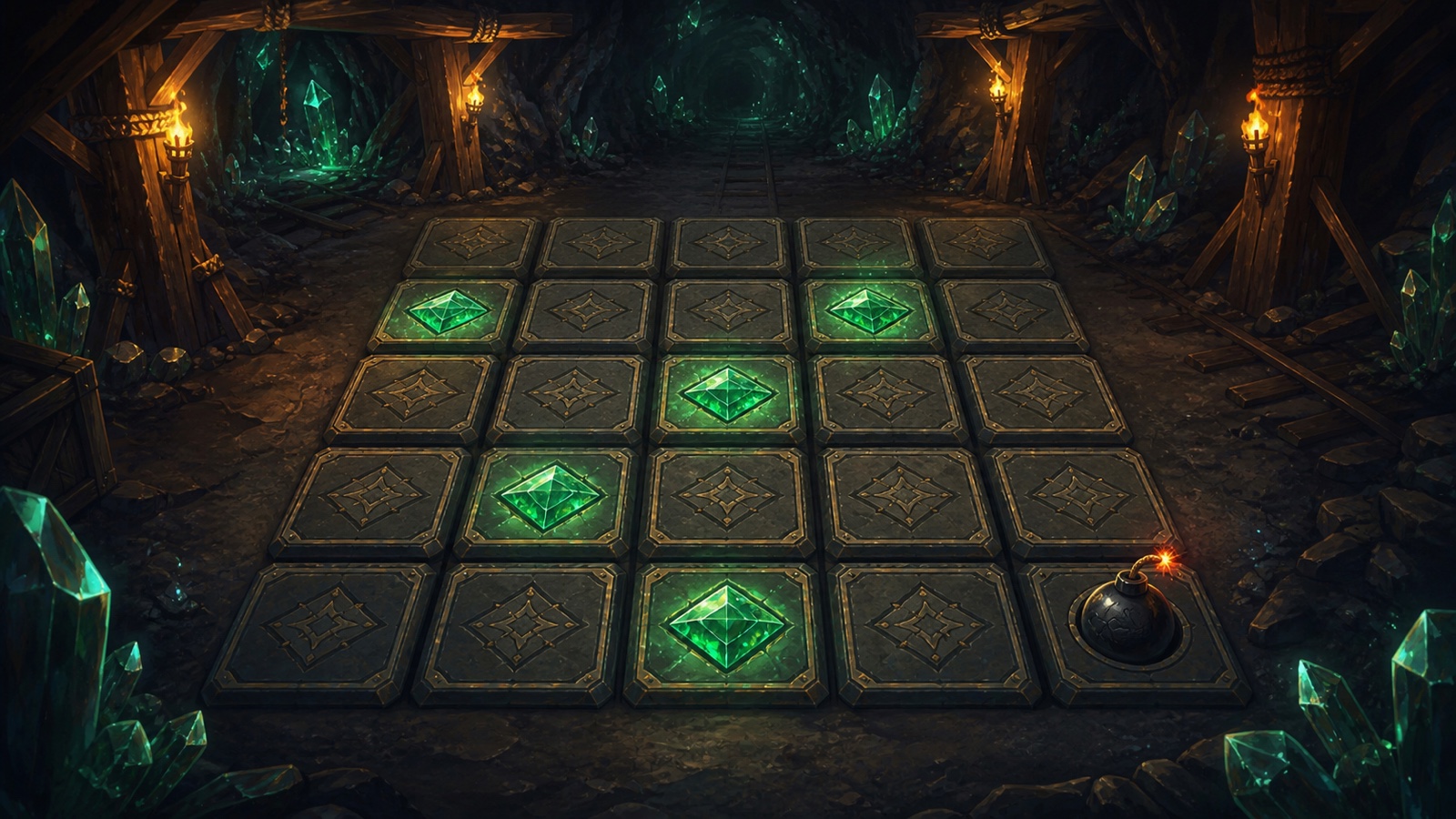
Gem Hunt gives you a board full of covered tiles and one question after every safe pick: take the current return or risk it on another tile? There is no timer pushing the decision. The tension comes from knowing that every gem lifts the multiplier while one powder bomb ends the round.
This guide explains the current Gem Hunt game as it is shipped on Havoc Win. It covers the 5×5 board, the 3, 5 and 10 bomb choices, the current and next multiplier displays, cashout, the 98.0% theoretical RTP and the proof attached to a completed round.
How to play Gem Hunt step by step
- Choose 3, 5 or 10 bombs. This setting is locked once the round begins.
- Set the stake. Check the total amount committed before opening the board.
- Start the round. The game service commits a complete hidden minefield for the 25 tiles.
- Open one covered tile. A gem is safe and moves the multiplier ladder forward. A bomb ends the round.
- Read Now and Next. Now is the multiplier you can collect. Next is the value after one more safe reveal.
- Cash out or continue. After a safe pick, bank the displayed return or choose another covered tile.
- Review the settled round. When you cash out or hit a bomb, the result and replay evidence are tied to that completed board.
You do not need to select several tiles in advance. Gem Hunt pauses after each safe reveal, so every new click is a fresh decision about the same active stake. That makes the board easy to learn, but it also makes it easy to talk yourself into one more pick. Decide your stopping point before the round rather than inventing it after a streak of gems.
What 3, 5 and 10 bombs change
The bomb count changes two things together: how many safe tiles remain and how quickly the cashout multiplier grows. More bombs mean a smaller safe share of the board, so the ladder has to rise faster to reflect the added risk.
- 3 bombs: 22 of 25 tiles are safe before the first pick, an 88% starting safe chance. The first safe reveal shows about 1.11×.
- 5 bombs: 20 of 25 tiles are safe before the first pick, an 80% starting safe chance. The first safe reveal shows about 1.23×.
- 10 bombs: 15 of 25 tiles are safe before the first pick, a 60% starting safe chance. The first safe reveal shows about 1.63×.
Those are not three difficulty labels wrapped around the same board. They produce different risk curves. The 3 bomb mode usually gives you more room to reveal tiles before the multiplier becomes steep. The 10 bomb mode starts with much less room for error and moves the displayed return faster when a pick is safe.
Higher risk does not mean better value. It means more losing boards and larger multipliers on the boards that survive. Pick the version whose pace you understand, not the one with the most dramatic number.
Why each safe pick becomes harder
A revealed gem removes one known safe tile. The bombs stay hidden among the remaining covered tiles. In 5 bomb mode, the first pick starts with 20 safe tiles out of 25. After one gem, the next pick has 19 safe tiles among 24 covered positions. After another gem, it has 18 safe tiles among 23.
That shrinking safe share is why the multiplier climbs. It is also why a long run of gems does not make the next tile safer. The board has given you more value to collect, but the next covered tile carries more risk than the first one did.
A bigger cashout value is payment for surviving more risk. It is not evidence that the next tile will be safe.
A worked 5 bomb example
Suppose you stake $1 with 5 bombs selected. The first safe reveal moves the displayed multiplier to about 1.23×. A second safe reveal moves it to about 1.55×, and a third moves it to about 1.98×.
If you cash out after the third gem, the round returns about $1.98 on the $1 stake, subject to the live settlement display and normal currency rounding. If you continue and the fourth tile is a bomb, the active stake and the uncollected 1.98× value are lost. The earlier gems do not create a separate balance that survives the bomb.
The Now and Next panel exists to make that tradeoff explicit. Look at both figures before every pick. Now is real only if you cash out. Next is conditional on surviving another reveal.
Can you use a pattern to avoid bombs?
No. Corners, diagonals, checkerboards and clusters of previous gems do not reveal the hidden layout. The server creates the minefield from the round’s committed random input, and the client uncovers that board one selection at a time. The artwork on a covered tile is presentation, not a clue.
Previous rounds do not help either. A bomb in the lower-right corner on the last board does not make that position safer or more dangerous now. The same is true after several losses. A new stake buys a new independent board, not a better chance because the game owes you a gem.
Gem Hunt RTP and house edge
Gem Hunt publishes a 98.0% theoretical RTP, equivalent to a 2.0% mathematical house edge over the long run. The multiplier ladder is calculated from the number of bombs, the number of safe reveals and that published edge.
RTP is an average across a very large number of wagers. It does not mean a $100 session should finish with $98, and it does not smooth out the difference between cautious and steep boards in the short term. A 10 bomb round can feel far more volatile even though it belongs to the same published game model. Our house edge and RTP guide explains why session results can sit far above or below the long-run figure.
How the hidden board stays checkable
Gem Hunt is server-authoritative. When a real round starts, the game service commits the complete board from its seeded random stream. Each click asks the service to reveal the selected position. The local flip animation does not move a bomb or decide whether the tile is safe.
Cashout is settled by the same service using the number of safe tiles already revealed. Once the round ends, its committed data and replay record make the completed result checkable. Read what provably fair means for the difference between verifying a result and predicting one.
Common Gem Hunt mistakes
- Choosing 10 bombs just for the larger number: the faster multiplier comes with a much smaller safe share.
- Treating the current value as money already won: it is not collected until cashout settles.
- Changing the plan after each gem: decide a pick limit or cashout rule before opening the board.
- Following tile patterns: every covered position is hidden by the same committed board, not by a visual hint.
- Chasing a bomb: the next board is independent, so a larger stake cannot repair the previous loss.
- Playing too quickly: the game has no timer, so there is no benefit to skipping the Now and Next values.
A sensible way to learn Gem Hunt
Open Gem Hunt in Fun play when it is available and start with 3 bombs. Pick a fixed stopping point, such as one or two safe tiles, and watch how the Now and Next values change. Then try 5 bombs with the same stopping rule. Changing one setting at a time makes the risk curve much easier to see.
Before balance play, set a total loss limit and a time limit. Do not raise the bomb count or stake to recover a previous board. Gem Hunt is chance-based entertainment for adults aged 18 or older where local law permits. The Havoc Originals guide can help you compare it with games that use a different pace and decision structure.
Frequently asked questions
How do you play Gem Hunt?
Choose 3, 5 or 10 bombs, set a stake and open tiles on the 5×5 board. Each safe tile reveals a gem and raises the cashout multiplier. You can bank after any safe reveal, but opening a bomb ends the round and loses the active stake.
What changes when I choose more bombs?
More bombs leave fewer safe tiles on the board, so every reveal is riskier. The multiplier ladder rises faster to price that extra risk. Choosing more bombs does not improve the game’s published theoretical RTP.
Can I cash out after one safe tile?
Yes. Once the first gem is revealed, the Cash Out button shows the current return. You can bank it or continue to another covered tile. If every safe tile is cleared, the game cashes the completed field automatically.
What is the RTP of Gem Hunt?
Gem Hunt publishes a 98.0% theoretical RTP, equivalent to a 2.0% mathematical house edge over the long run. It is not a promise that one board or session will return 98% of its stakes.
Can tile patterns reveal where the bombs are?
No. The server commits the hidden board when the round starts. Tile position, previous boards, gem animations and recent losses do not provide information about which covered tile is safe next.